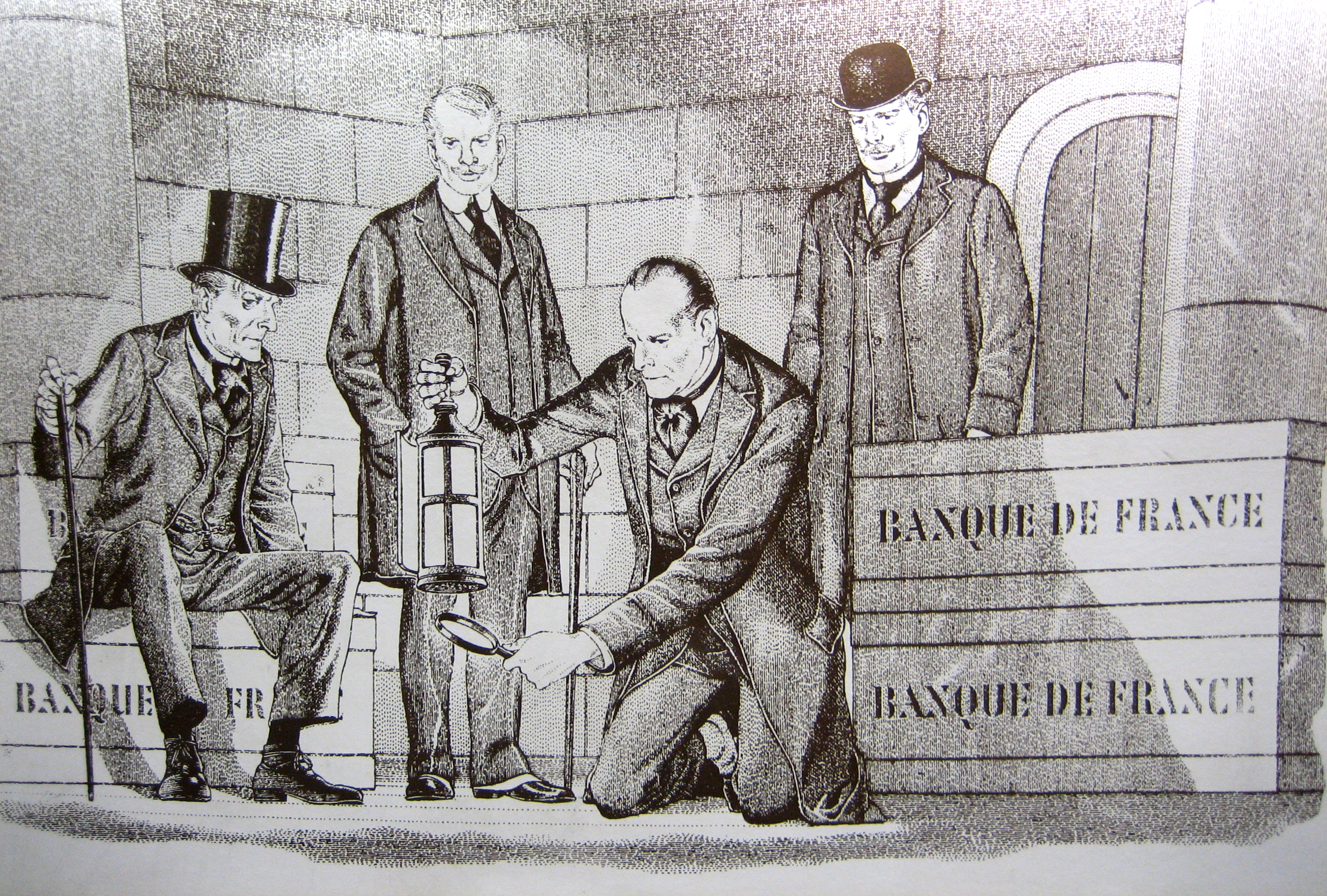
 “Watson!”
It was an ejaculation I had come to know well over the course of the last few years, but one delivered rarely with such intense potency and urgent inquiry.
I abandoned the correspondence to which I had been attending with, I admit, only a cursory interest, and hastened downstairs from my room.
“Oh really, this is too much. Too much!”
That familiar voice bore traces, I surmised, of an unexpected quality with which I had only fleeting acquaintance. Looking back I realise it could best be described as personal slight.
With studied detachment I surveyed the scene.
Sherlock Holmes lay prostrate upon a chair at least one size too small for his commanding frame. His arms hung by his sides limply and his face was turned, not toward me or one of the room’s broad windows, but to the ceiling, upon which his hooded eyes gazed with equivocation.
My unease was deepened as I took in the appalling ensemble gathered at the man’s feet.
At first glance it appeared as if a spring tide of discarded newsprint had washed up on the carpet. But on closer inspection I saw that the sheets of paper bore traces of human intervention, probably ripped and torn by the hands of the person around whose slippers they coalesced implausibly.
Without waiting for admission I waded through the detritus and opened one of the windows, in an effort to dilute the thick atmosphere of smoke and contempt already assailing my senses.
“I have failed to keep a count,” I began, “of the number of occasions I have cautioned you as to a purposeful ignorance of the benefits of fresh air.”
A snort came from the prone figure on the chair.
I flung open the window, through which a reassuring cavalcade of noise from Baker Street tumbled.
“Did I give you permission to sanction such an undignified intrusion?” Holmes snapped, his face continuing its now somewhat stubborn disavowal of my presence.
‘I’m sorry?”
“The window! My dear Watson, today has already witnessed more than an average assault by the lumpen forces of the common man upon these chambers. Must you insist on compounding this malady with the cries of a discomfited fruit-seller or a passing hurdy-gurdy?”
Holmes let out another snort and, before I could respond, extended a sinewy arm in the direction of one of the pieces of newsprint that lay upon the floor.
“I hold you responsible for this, Watson!” he cried, and lurched in his chair as if the fresh air that was now making an overdue ingress into the room had punched him in the stomach.
I picked up the paper towards which he gestured, then sat down to study its contents.
I let out a gasp, then fell quiet.
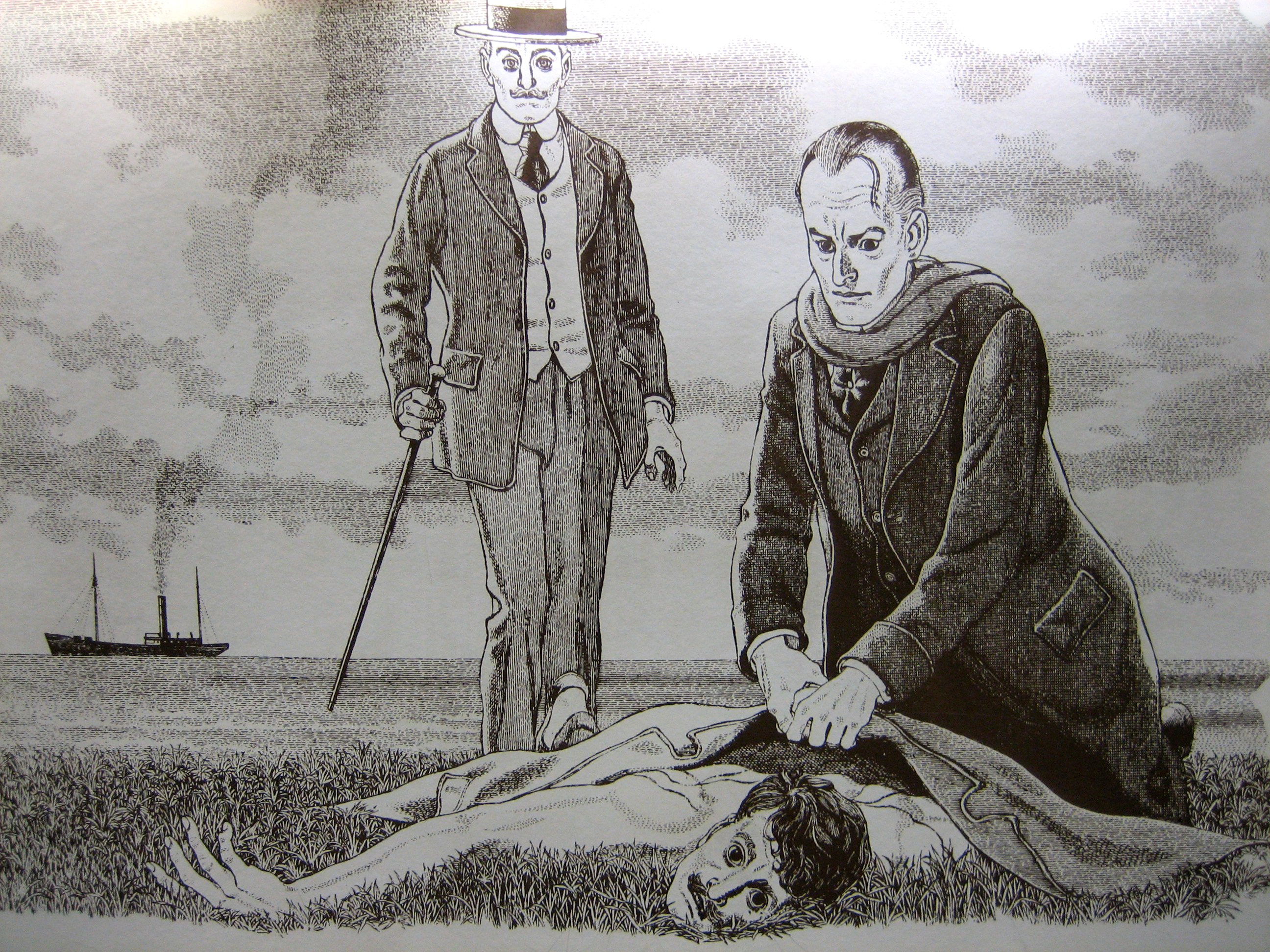 “Watson, your propensity for knowing silences has exceeded itself,” laughed Holmes, as he jumped to his feet and strode over to the window.
It was true that I had been rendered temporarily unable to speak, yet my mind was akin to a cacophony of confusion.
“Ha! Just as I thought!” Holmes exclaimed.
I glanced up to find him peering through the window and along the street.
“But it is of little consequence,” he added, before reeling around to face me, slamming the window shut in the process.
It was the first time he had looked at me directly since I had entered the room.
His face was creased into the expression of a man assailed by a great blasphemy, yet leavened with a trace of the absurd.
“What do you make of it, Watson?”
I forced out a sentence.
“Holmes, let me say first of all that I had no knowledge of this, none whatsoever.”
“That much I had already deduced.”
“I find that I cannot comprehend the motive.”
“Watson, you are nothing if not dependably predictable.”
He strode over to the doorway and called out, in no particular direction: “Mrs Hudson! We have visitors!”
I swung round to address him, still clutching the newspaper cutting.
“Nor do I find your countenance particularly agreeable,” I declared.
Holmes fell silent. His shoulders sagged. A sigh escaped his lips and he began fumbling in the pockets of his house coat.
“I had, it must be said, expected such an eventuality. I curse myself for not anticipating it quite so soon.”
I stared down at the piece of paper, from which my own face stared straight back.
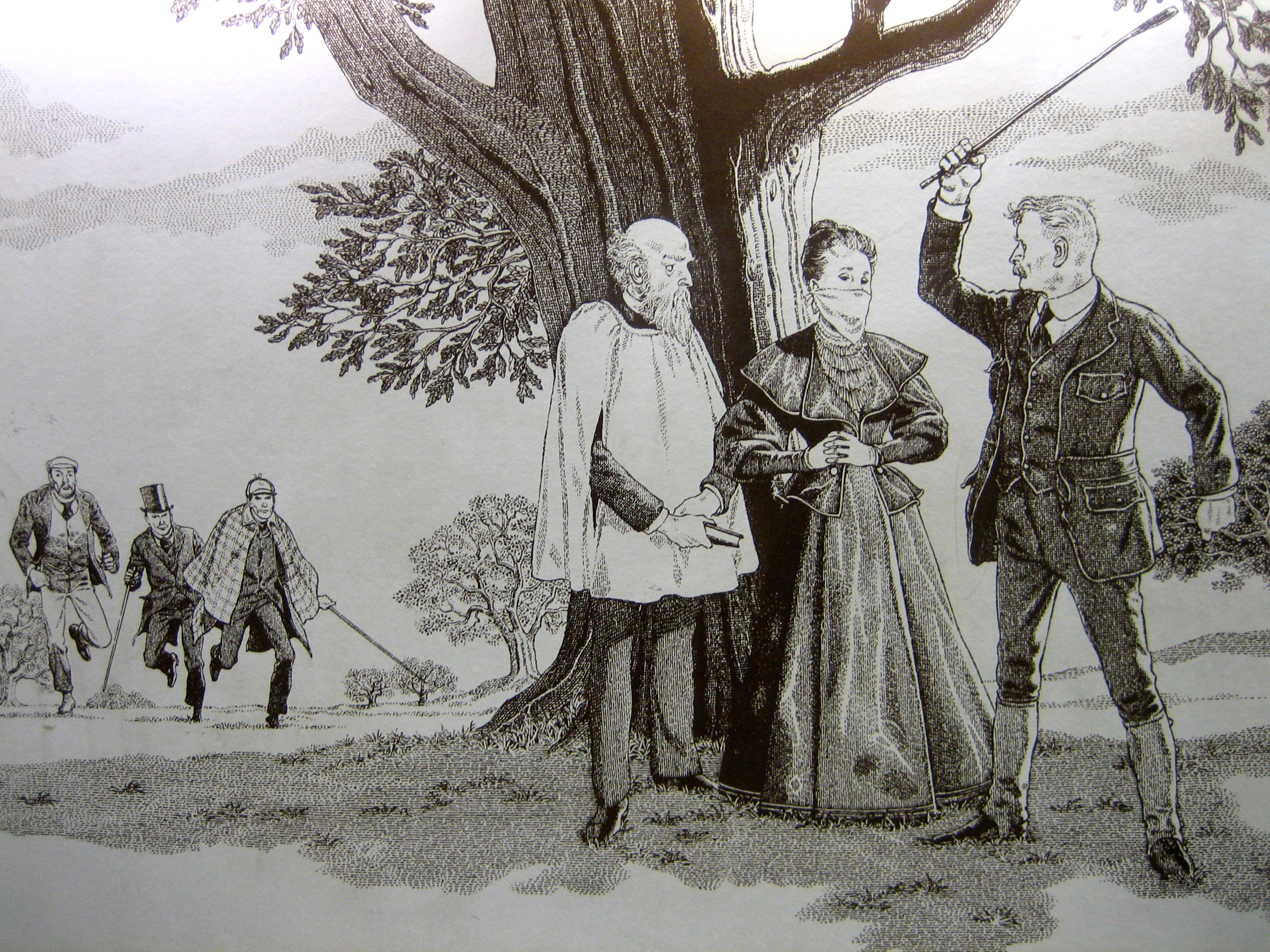 The likenesses of both myself and Holmes set in motion a vague rankling. And yet I could not deny within me a rising feeling of satisfaction, even pride.
Holmes arranged himself tartly within an armchair and worked on his pipe.
“I trust you noticed that it is always I who am depicted experiencing a moment of great epiphany, while you, dear fellow, forever discharge the role of the hapless, nay irrelevant, bystander.”
“Now wait a moment,” I began, rising to Holmes’s calculated slight. “Were it not for my accounts of your activities, such illustrations would not even exist.”
“And if only it were so!” he shouted. “These trivial etchings further poison my already maligned profession, one which your literary forays have eroded with insipid regularity.”
“I refuse to accept that you believe that,” I stated, calmly.
Holmes leaped to his feet.
“Oh, the debasement!” he wailed. “That such advancements in my field should end up rendered in such ordinary a fashion.”
“Nonsense,” I replied. “These caricatures, though lacking in artistic ambition, I find to be rather appealing.”
Holmes fired me a glare infused with accommodating contempt.
There was a knock on the door.
“As expected,” Holmes boomed.
Mrs Hudson entered, then Inspector Lestrade, his face looking more pinched than usual.
They were followed by a figure whom I did not recognise, but whose deportment struck me as somehow familiar.
“Good afternoon gentlemen,” recited Lestrade, “and how flattered I am to be in such honoured presence.”
“Dry humour does not befit you,” said Holmes. “But I see you have brought company, and if I have appraised correctly, a senior employee of one of this city’s growing number of railways.”
“Why, the Metropolitan!” I exclaimed, spying the man’s familiar livery. “I’m surprised you missed that detail, Holmes.”
Holmes’s eyes darted not unkindly in my direction, then settled upon the guest.
“Sir, you need not waste time in outlining the reason for your visit. Pray, supply us with the end to which you have contrived these means. My good friend Dr Watson would be most interested to hear them, and I confess it would bring me not a little amusement.”
 The man, who Lestrade introduced as a senior figure within the management of the Metropolitan Railway, adopted a stance of contrition.
“Sirs, I must apologise. A sequence of events is under way about which you both should have been given advance notice. I had intended this to be a gesture conceived in respect. I fear, now, it has been taken as one of grotesque impertinence. I am truly sorry. I will withdraw the illustrations from circulation forthwith.”
“Your bearing does you credit,” began Holmes, “but your proposal does not. I have no objection in principle on these… entertainments being used by you and your organisation. My hesitations are purely subjective and therefore irrelevant in this matter. I’m sure my friend Dr Watson bears you no fundamental ill-will other than residual disquiet that no prior communication was given. I am not certain that this initiative will endure, in fact I am positive it will be of no interest to the people of this city beyond, say, the next 10 years. However please thank the illustrator for his efforts and keep me informed of the success or otherwise of this trivial venture.”
His soliloquy over, Holmes rose and moved once again to the window, his eyes searching for a fresh matter upon which to reflect.
Our visitor turned in my direction. “Dr Watson, my appreciation. Perhaps you would do me the courtesy of attending a dinner that is being organised in honour of your good self and Mr Holmes? It is but round the corner, at Baker Street station.”
“I would be delighted, though I cannot answer on behalf of Holmes.”
“I will also be in attendance,” Lestrade announced, to little purpose.
The visitor seemed keen suddenly to leave our premises as quickly as possible. “Very well, all the appropriate arrangements will be made and – this time – you will be properly informed. But goodness me, the day is getting on and the demands of the railway are never sated!”
Chuckling with private amusement, he left the room escorted by Mrs Hudson, followed by Lestrade, who exited exhibiting the same indifference with which he arrived.
Holmes and I were alone again.
I let out a quiet whistle.
“Well, well. That was a turn-up!”
Holmes remained silent.
“I had expected you to cast this man from our house,” I continued, “and instead I find you letting him go with barely a reprimand.”
Holmes turned to face me. He bore the look of a man suddenly weary from a legacy yet to come.
“My dear friend. You and I have but only a score of years left. I suspect, and at times fear, aspects of our endeavours will persist somewhat longer. Perhaps these illustrations may endure 100 years or more – the Metropolitan Railway also. We can no more condemn the course of the future as we can regret the follies of the past. Now come: pass me that sole intact edition of this morning’s Times, for I surmise there is a development in the case of Cadogan West and the missing submarine plans.”
 150 great things about the Underground